
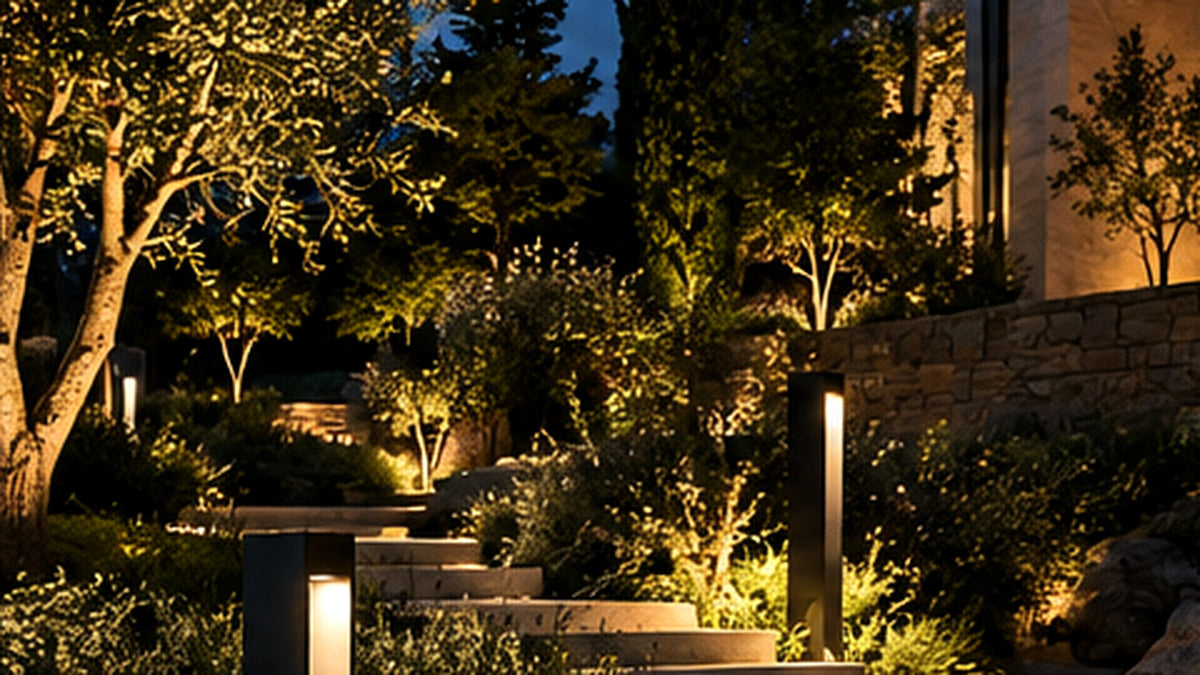
A beautifully lit garden path should be easy to follow without feeling overlit. The ideal outdoor pathway lighting scheme reveals changes in level, supports orientation and adds depth to the landscape—all while keeping the surrounding night comfortable.
Three common fixture types often appear on the same drawing: bollard lights, step lights and in-ground luminaires. They are not interchangeable. Each solves a different problem, and knowing when to use each one makes specification and installation much easier.
The quick comparison
| Fixture type | Best starting use | Key planning question |
|---|---|---|
| LED bollard lights | Open paths and garden circulation | Will the light be comfortable from every approach? |
| Step luminaires | Stairs, risers and changes of level | Will treads and edges be visible without glare? |
| In-ground luminaires | Landscape accents and selected edges | Can the installation manage water, drainage and load? |
In most projects, a combination works better than forcing one fixture to handle every lighting task.
When to use bollard lights
A bollard luminaire puts the light source above ground on a short post. It can define a route across planting beds, along a driveway approach or beside a pedestrian path where there is no nearby wall to mount a light.
Bollards are visually present during the day, so their shape and finish also matter. For a contemporary residential garden, a simple dark finish can blend into planting. In commercial landscapes, a more visible form may help people read the route.
Look for a distribution designed to illuminate the ground without shining into people's eyes. Shielded or asymmetric optics can reduce direct glare. Rather than specifying a single spacing distance for every path, base the layout on luminaire photometry, mounting height, path width and required illumination.
Best for: open walkways, landscaped courtyards, garden circulation and low-level public routes.
When step lights are the better choice
Step luminaires help users identify risers and walking surfaces where levels change. They are particularly useful on exterior stairs, terraced gardens and short connecting flights between patios.
An integrated, recessed step light can deliver useful illumination without adding a visible post. However, placement is important. A luminaire that looks elegant in a rendering can be uncomfortable when a person climbs the steps directly toward it.
Coordinate the fixture with stair materials, edge details and wiring access. Check that the design avoids both direct glare and misleading shadows. Where building codes or accessibility requirements apply, lighting layout must be checked against those requirements rather than relying on appearance alone.
Best for: stair risers, retaining-wall steps, landings and transitions between levels.
When in-ground luminaires make sense
In-ground luminaires sit flush or nearly flush with paving, gravel borders or planting areas. They are often used to uplight trees, columns, architectural details or selected landscape elements. They can also help define a route indirectly when placed thoughtfully.
Their discreet appearance is attractive, but the installation is typically more demanding. A recessed fitting may be exposed to standing water, debris, soil movement or maintenance vehicles. Check drainage, cable access, lens temperature, suitable load rating and manufacturer installation instructions.
Importantly, an uplight pointing toward the sky is not always an appropriate solution. Consider the viewing direction, spill light and effects on neighboring spaces before choosing it.
Best for: discreet accents, tree lighting, architectural uplighting and selected landscape edges—not as the default solution for every walkway.
Five planning decisions that improve a pathway scheme
1. Decide what users need to see
Start with the task: locating the path, seeing changes in level, recognizing a destination or enjoying the surrounding planting. These needs determine where light is useful; the total number of fixtures comes later.
2. Design a rhythm, not a runway
Perfectly uniform rows can feel institutional in a small garden. Alternating carefully placed bollards with modest step lighting and selective planting accents can make the space feel calmer. Just keep necessary walking surfaces legible and avoid creating dangerous bright-to-dark transitions.
3. Control glare from seated and standing views
Evaluate the scene from several positions: walking toward a fixture, sitting on a terrace and looking out from interior windows. Low-mounted luminaires can still cause uncomfortable glare if the LED source is exposed. Cut-off design and careful aiming matter.
4. Choose color temperature with the landscape
Warm-white light can feel natural beside timber, stone and planting, while a different tone may suit an explicitly contemporary public project. Consistency across a single garden usually matters more than choosing one universally “correct” number. Use only as much blue-rich light as the application needs.
5. Plan for the local outdoor environment
Verify the required IP protection under IEC 60529, then look beyond that rating: installation location, corrosion exposure, drainage, temperatures and future replacement all affect suitability. Product drawings should show how the luminaire mounts, seals and connects.
Example: a layered residential entrance route
Imagine a modern house with a gate, a curved garden path and three steps to the front door. A practical concept might use shielded bollards along the open section, recessed step lights at the level change, and one carefully aimed landscape accent on a feature tree. The intention is not to make every surface bright. It is to create a coherent journey from gate to entrance.
For a larger hospitality or commercial project, the same layered approach applies, but the designer must also consider footfall, accessibility, operating hours and site-specific requirements.
Buying checklist for distributors and contractors
Before comparing offers, request the following for each fixture type:
- Product drawings with exact mounting dimensions and recommended clearances.
- Photometric files and lumen information for the chosen optic.
- CCT, finish and applicable control options.
- IP rating and any relevant installation or load limitations.
- Cable entry details, driver requirements and spare-parts policy.
- Warranty terms, required certifications and test documentation where applicable.
Treat project mock-ups and photometric calculations as design tools, not optional decorations. They help resolve glare and spacing questions before procurement.
Frequently asked questions
Are bollard lights good for narrow pathways?
They can be, provided the footprint, brightness and beam pattern suit the path. For very narrow routes, wall-mounted or step-mounted solutions may use the available space more efficiently.
Can in-ground lights replace step lights?
Sometimes an integrated design can achieve a similar outcome, but uplights can introduce glare or fail to reveal stair edges clearly. Evaluate the intended visibility and applicable regulations before substituting them.
How far apart should pathway bollards be?
There is no safe universal spacing number. Use the fixture's photometric distribution, height, site geometry and project lighting criteria to test an initial layout.
The best pathway lighting feels effortless
Good garden and pathway lighting is less about the number of fixtures than about where each beam goes. Choose bollards for open circulation, step lights for level changes and in-ground luminaires for selected accents. For BTR projects, a clear site plan and a short note about how people use the route are the best starting points for recommending a suitable fixture family.
Further reading: DarkSky: Five Principles for Responsible Outdoor Lighting · IEC 60529: IP Code


